 scenario-wedding-marketing
 September 28, 2026
 scenario-wedding-marketing
There are weddings where the décor becomes the backdrop. And then there are weddings where the entire setting becomes part of the story. Thirukallyanam – The Divine Wedding belongs to the latter. For a wedding planner for destination wedding celebrations, the true challenge is not simply creating a beautiful setting, but understanding the couple, their heritage and the destination they have chosen, and bringing these elements together to create an experience that feels deeply personal. For Anamika and Aditya, that meant creating a celebration where the architectural legacy of Hampi could meet the traditions and natural beauty of Kerala – transforming their wedding into an experience their guests could see, feel and become part of.
Childhood friends whose relationship eventually grew into a lifelong commitment, they envisioned something traditional, elegant and deeply personal – a celebration that would feel meaningful to them and leave their guests with an experience they had never encountered before.
Their story brought together two distinct cultural worlds.
Aditya’s connection to Hampi, with its monumental temples, ancient stone architecture and rich heritage, met Anamika’s Kerala roots, shaped by timeless rituals, natural beauty and a distinctive cultural identity.
The challenge was not to choose one tradition over the other. It was to find a way for both worlds to exist naturally within the same celebration.
That became the heart of Thirukallyanam.
The couple’s brief was deceptively simple.
They wanted something deeply traditional, but not predictable. Elegant, but not excessive. Grand, but still calm.
Most importantly, they wanted the wedding to feel like them.
That last part shaped the entire planning process.
Anamika and Aditya were known for noticing details. Every texture, suggestion and design decision was discussed carefully. That meant the creative process could not be based on a ready-made wedding template.
The concept had to withstand scrutiny from every angle.
The answer came through architecture.
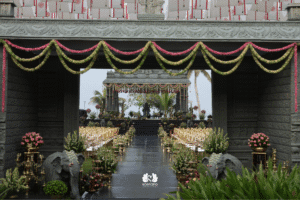
Instead of creating a conventional floral mandapam, the team imagined a stone-finished temple-inspired wedding environment, drawing from the ancient visual language of Hampi while allowing Kerala’s traditions to naturally become part of the experience.
The result was eventually described as Kerala’s first stone-finished temple-inspired wedding celebration.
It was not simply a temple theme.
The architecture itself became the centre of the wedding.
For a wedding planner for destination wedding celebrations, this is where creative planning begins — not with a catalogue of décor options, but with understanding the couple’s heritage and finding a way to translate it into the destination itself.
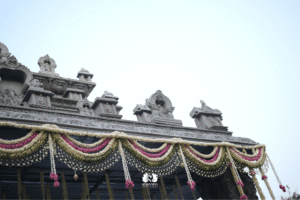
At the heart of the celebration stood a 24-foot mandapam, designed with Karingallu, the distinctive black stone associated with Kerala architecture.
Stone textures, carved elements, temple-inspired detailing, brass accents and antique properties created a sense of permanence.
The intention was never to make the mandapam look like a temporary wedding structure dressed up to resemble a temple.
It needed to feel as though it belonged there.
That required a very different approach to fabrication.
Stone-finish treatments can easily appear artificial when the texture, colour or surface treatment is inconsistent. So the process involved testing finishes, refining tones and closely supervising fabrication and installation.
Every surface mattered.
Every transition mattered.
The team worked through those details until the finished mandapam felt less like something assembled for an event and more like an architectural structure that had emerged from the landscape.
That distinction is important.
Luxury wedding design is often associated with the sheer amount of décor used.
Thirukallyanam took the opposite approach.
The material itself became the luxury.
The colour story followed the architecture rather than competing with it.
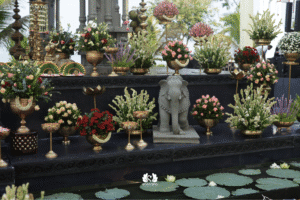
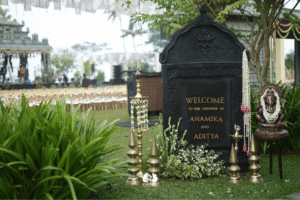
Stone grey, antique gold, ivory, blush pink and deep maroon created a restrained palette that allowed the textures to remain visible.
The brief called for a setting that felt sacred and magical, and the design achieved that without relying on visual excess.
The stone provided strength.
The brass introduced warmth.
The ivory softened the environment.
The blush tones added delicacy.
The deeper maroon accents gave the setting depth.
Together, these elements created an atmosphere that felt sophisticated without losing the character of a traditional Indian wedding.

The floral design followed the same philosophy.
Rather than covering the architecture with flowers, the floral elements were carefully layered into the stone environment.
Lotus, jasmine, roses, Rajanikantha and oleander brought colour, fragrance and softness into the setting. Jasmine helped soften the darker stone textures, while lotus reinforced the ceremonial character of the space. Roses introduced a quieter romantic note.
This restraint was deliberate.
The flowers were there to complement the architecture.
They were not there to hide it.
Natural daylight also played an important role.
Instead of depending entirely on artificial lighting to create drama, the design embraced Kerala’s natural light, allowing the stone surfaces, flowers and surrounding landscape to change throughout the day.
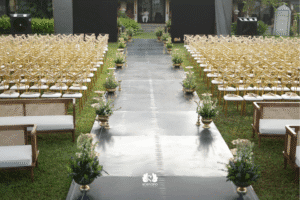
The wedding was hosted at Gokulam Grand Kumarakom, surrounded by the peaceful character of Kerala’s backwaters. The open skies, water reflections and natural setting offered a very different canvas from a conventional indoor ballroom.
That openness was both an advantage and a challenge.
There was beauty everywhere, but there was also wind, weather and an environment that could not simply be controlled like an indoor venue.
The design therefore had to work with the landscape.
A water body surrounded the mandapam, adding depth and serenity to the structure. The movement of the breeze became part of the experience, particularly as the fabric above the mandapam moved gently with the air.
The setting did not merely frame the wedding. It participated in it.
This is also where the role of a wedding planner for destination wedding celebrations extends beyond design. A destination brings its own landscape, weather, logistics and cultural character, and each of these elements needs to be considered when developing the wedding experience.
One of the most technically demanding parts of the installation was almost invisible to the guests.
The mandapam itself stood at 24 feet.
Above it, a large fabric canopy was created, requiring a support structure that rose to approximately 28 feet to preserve the visual openness of the design.
But the open landscape meant that wind became a constant factor.
The breeze that made the setting feel alive was also capable of moving and pulling the fabric throughout installation.
The team had to repeatedly adjust and secure the draping until the structure achieved the right balance between movement, stability and visual precision.
That is one of the less visible realities of destination wedding production.
A guest sees fabric moving beautifully above a mandapam.
They don’t see the hours spent making sure it moves beautifully and safely.
The wedding was also significant in scale.
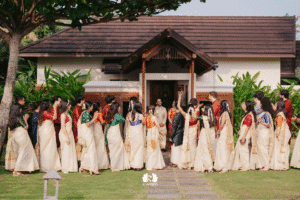
Approximately 600 guests attended across five major celebrations – Haldi, Mehendi, Sangeet, Wedding and Reception.
Large guest counts can easily change the character of a wedding.
A space that feels intimate with 200 people can feel entirely different with 600.
So the planning extended far beyond décor.
Guest movement, seating, dining circulation and transitions between rituals had to be considered carefully. The venue was spatially mapped so guests could move comfortably while the atmosphere remained composed.
The aim was not simply to accommodate everyone.
It was to make the scale feel effortless.
That is one of the defining differences between designing an event and orchestrating an experience.
The guest should never have to think about how complicated the logistics are.
They should simply feel that everything works.
For a wedding planner for destination wedding celebrations, this operational layer is just as important as the visual design. When hundreds of guests are travelling to a destination, every movement, transition and moment of the celebration needs to feel considered, from their arrival at the venue to the final event of the wedding.
The wedding had been planned for approximately a year.
Yet the final execution window was extremely demanding.
The design evolved several times as the couple refined their vision. Then came the Sangeet, scheduled just one day before the wedding, leaving very little time for the main décor transformation.
That meant the production team had to work differently.
Additional manpower was deployed.
Installation teams operated simultaneously.
Overnight execution was divided into phases.
Supervisory checkpoints were introduced to maintain quality.
The pressure existed behind the scenes, but it could not be visible in the final experience.
When the guests arrived, the venue needed to look calm, finished and intentional.
And that is exactly what disciplined event production is supposed to achieve.
The complexity is absorbed by the team so that the celebration feels simple to everyone else.
A wedding of this scale cannot be created by one team working in isolation.
Venue truss vendors, music teams, mandap artists, structural teams, floral designers and logistics coordinators all had to work together.
The challenge was not simply getting everyone to complete their own tasks.
It was ensuring that each task connected seamlessly to the next.
The structural team had to understand the design.
The floral team had to work around the architecture.
The lighting and technical teams had to respect the visual intent.
Logistics had to work around guest movement.
And every team had to work within the same compressed timeline.
The finished wedding therefore represented much more than a design concept.
It represented coordination.
Perhaps the most memorable detail of Thirukallyanam was one of the simplest.
Bells.
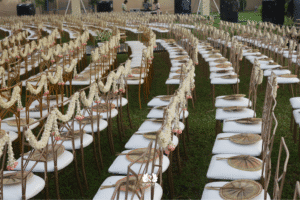
During the thalikett, bells were placed behind the guests’ chairs.
When the sacred moment arrived, the guests were invited to ring them together.
The sound of hundreds of bells joined the chanting and the natural movement of the wind.
It wasn’t a performance planned to impress the audience.
It was a ritual that allowed the audience to participate.
And that changed the emotional character of the moment.
Instead of watching the wedding from a distance, the guests became part of it.
The brief describes the resulting sound as a kind of divine chorus – a spontaneous shared experience that guests remembered long after the ceremony.
That is the kind of detail that cannot be achieved simply by increasing the décor budget.
It comes from understanding how people experience a celebration.
The outdoor environment also brought another consideration: Kerala’s warm and humid weather.
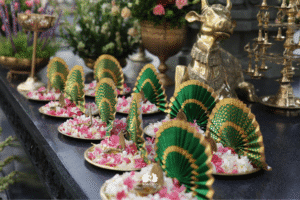
Bamboo hand fans were placed behind the guests’ chairs to keep them comfortable.
But even this practical element became part of the design.
The fans featured the traditional Kerala Kasavu pattern, with white and gold borders. They subtly brought Kerala’s visual identity into a celebration whose architectural language was heavily influenced by Hampi.
It was a small gesture.
But it demonstrated an important principle of thoughtful wedding planning:
Guest comfort does not have to exist separately from aesthetics.
When designed properly, practical details can become part of the story.
The scale and sophistication of the wedding did not mean everything had to be created for one day and discarded afterwards.
Reusable décor formed an important part of the planning approach.
Structures, including chairs and stage platforms, were designed with future adaptation in mind. Floral and plastic waste were segregated, waste materials were carefully removed, and installations were planned to minimise unnecessary material consumption.
This approach adds another dimension to modern luxury.
Luxury is not simply about creating more.
It is about creating intelligently.
The objective is to achieve impact while being thoughtful about the materials, structures and resources used to achieve it.
When asked how much of the wedding was personalized, the answer was essentially: everything.
The stone temple concept itself came from the couple.
The design was then refined through conversations, approvals and changes until it reached the version they felt represented them.
That involvement was important because personalization isn’t about adding the couple’s initials to a menu card or choosing a favourite flower.
It is about making decisions that would not have been made for another couple.
The architecture.
The cultural references.
The colour palette.
The guest participation.
The balance between Hampi and Kerala.
Even the way the natural landscape was incorporated.
Together, those decisions made the wedding unmistakably theirs.
By the time the celebration came to life, Thirukallyanam had become more than an exercise in wedding décor.
It was a meeting point between two families and two cultural identities.
It allowed Hampi’s architectural language to meet Kerala’s rituals and natural environment without forcing either one into the background.
The result was traditional without being predictable.
Grand without being overwhelming.
Contemporary without losing its cultural soul.
And perhaps most importantly, personal without becoming overly literal.
A destination wedding is often sold through images of beautiful landscapes, luxury resorts and spectacular décor.
But the destination itself is only the beginning.
The real opportunity lies in asking what that place can contribute to the couple’s story.
At Thirukallyanam, the setting offered water, open skies, natural light and a distinctly Kerala atmosphere.
The couple brought their own heritage and memories.
The design connected those elements.
That is where the role of a wedding planner for destination wedding celebrations becomes much broader than arranging vendors or styling a venue.
It means understanding the destination.
Understanding the couple.
Understanding the traditions.
And then finding the space where all three can coexist.
A wedding planner for destination wedding celebrations therefore has to think beyond the wedding day itself. The destination becomes part of the guest experience, while the couple’s story determines how that destination is transformed into something personal.
The strongest indication of the wedding’s success came from the people who experienced it.
Guests reportedly described it as something they had not seen in recent times, while the couple expressed deep satisfaction with the final result. Some guests personally approached the team at the end of the celebration to share their appreciation.
That response is significant.
Not because a wedding needs applause.
But because it shows that the design achieved what it set out to do.
It made people feel something.
The stone mandapam created the visual impact.
The flowers softened it.
The water and landscape gave it atmosphere.
The rituals gave it meaning.
The bells gave guests a role.
And the planning behind it all made the experience feel effortless.
The photographs tell another part of this story.
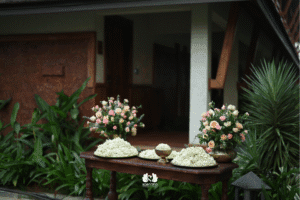
From the towering stone-finished mandapam and carefully layered florals to the Kerala-inspired details, sacred rituals and moments shared with family and friends, the Thirukallyanam Wedding Portfolio captures the celebration through the lens.
The role of a wedding planner for destination wedding celebrations is ultimately to bring all these elements together – the couple’s story, their heritage, the destination, the design and the experience of everyone attending.
There is no single formula for a memorable destination wedding.
For Anamika and Aditya, it was found in stone.
In Hampi | In Kerala | In temple architecture | In the sound of bells.
In the breeze moving through an open-air mandapam.
And in the quiet satisfaction of seeing a vision that began as an idea become a place where hundreds of people could celebrate together.
That is ultimately what meaningful wedding planning is about.
Not simply creating something beautiful.
But creating something that could belong to no other couple in quite the same way.
Thirukallyanam was not designed to be another grand wedding.
It was designed to be theirs.
And that is what made it extraordinary.
A destination is never just a backdrop for a wedding. The landscape, architecture, climate and character of the location can influence everything from the design concept to the guest experience.
Kerala offers an extraordinary range of settings for couples looking to celebrate somewhere meaningful – from serene backwaters and heritage properties to beaches, hill stations and luxury resorts. If you’re exploring different possibilities for your own celebration, our guide to destination weddings in Kerala explores some of the most beautiful wedding locations across the state.
For Thirukallyanam, the setting at Kumarakom provided exactly what the celebration needed: open skies, natural surroundings and the calm beauty of Kerala’s backwaters, allowing the temple-inspired architecture to become part of the landscape rather than compete with it.
Looking for a Wedding Planner for Your Destination Wedding?
Let’s create a celebration that brings your vision, heritage and personality to life.
Talk to Our Wedding Planning Team!